Happy new year! I hope 2013 turns out to be a better year personally (injuries and all that) and for everyone else (economy and all that).
I've just returned from another visit to the physio who said I should buy two of these and try a practice session to see how I get on. First I need to complete my final design degree project and hand in on the 11th, thus completing just short of 6 years of study - im finally out of jail!
Therefore, in a few weeks I should have my first practice in six months and almost 12 months to the day from my initial injury. However, I wont be rushing into it, I'll prob only do half sessions for a couple of weeks.
P.S. One thing I have noticed. I have only suffered one cold since my hiatus from kendo. Therefore, i'm suffering due to lack of sleep, running my body down or surrounded by diseased kendoka. Its probably a combination of all three! Im not looking forward to the regular illness again.
Edit (20-01-13):// Sods law. I was planning on my first practice last Friday but ive injured my left hand side intercostal muscle (muscles between ribs). I think it was through a combination of gym and cycling. I have to rest for a further 3-4 weeks.
It looks like my bad luck is continuing :(

Thursday, 3 January 2013

Saturday, 24 November 2012
Injury Update
After regular visits to the physio things have started to improve. I can now rotate my wrist with minimum discomfort, only occasionally tweaking it when opening doors or lifting something heavy. Its also a little stiff and achy when cold.
Considering my whole wrist and forearm was in bits earlier this year, the pain has now localised to a very small area near the ulna. This is a major improvement in regards to everyday life, not just kendo.

During the last 4-5 months i've been strengthening both wrists using weights and a claw hammer. The hammer is used to twist the wrist left then right, building up rotational stability.
I'm pretty confident that I'll be able to return to practice late January. How long I can last is another matter.
Considering my whole wrist and forearm was in bits earlier this year, the pain has now localised to a very small area near the ulna. This is a major improvement in regards to everyday life, not just kendo.

During the last 4-5 months i've been strengthening both wrists using weights and a claw hammer. The hammer is used to twist the wrist left then right, building up rotational stability.
I'm pretty confident that I'll be able to return to practice late January. How long I can last is another matter.
Friday, 21 September 2012
Disappointing News
Just back from the specialist who explained my wrist situation.
First my left, he outlined a series of bruised bones in my lower palm area, where the bottom of the shinai tsuka sits and you squeeze with the bottom fingers. The doc explains this is the result of an impact injury. I suggested this could be the result of tenouchi and the sword slamming into my palm from cuts and tsuki - he seemed to agree.
The doc said this should recover after a few more months of rest.
News about my right wrist was more depressing. He highlighted a slight tear in the cartilage which is the suggested cause of the pain. He has referred me back to the physio so I can return to rehab work.... however, if this doesn't improve I have to make a decision whether to live with the pain or give up kendo.
The realisation that I may not be able to continue is only just dawning on me.
Anyway, i'm out of action to January 2013 and will assess the situation then. Until this time I doubt i'll post many more messages.
First my left, he outlined a series of bruised bones in my lower palm area, where the bottom of the shinai tsuka sits and you squeeze with the bottom fingers. The doc explains this is the result of an impact injury. I suggested this could be the result of tenouchi and the sword slamming into my palm from cuts and tsuki - he seemed to agree.
The doc said this should recover after a few more months of rest.
News about my right wrist was more depressing. He highlighted a slight tear in the cartilage which is the suggested cause of the pain. He has referred me back to the physio so I can return to rehab work.... however, if this doesn't improve I have to make a decision whether to live with the pain or give up kendo.
The realisation that I may not be able to continue is only just dawning on me.
Anyway, i'm out of action to January 2013 and will assess the situation then. Until this time I doubt i'll post many more messages.
Wednesday, 29 August 2012
Still out of action
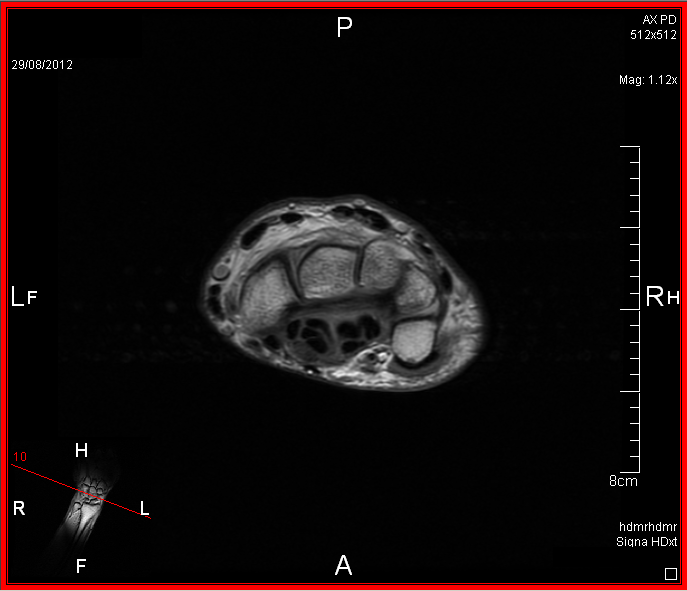
Over a month has passed since my grading and still no kendo. My physio suggested I get an expert opinion on the injuries so have since seen a rheumatologist and completed MRI scans on each wrist.
I've posted a few example pics, sadly you need to be an expert to know whats going on as I have no idea. My next appointment with the specialist is late September.
During this down time i've discovered road cycling which will hopefully keep me fit while i'm out of training.


I've posted a few example pics, sadly you need to be an expert to know whats going on as I have no idea. My next appointment with the specialist is late September.
During this down time i've discovered road cycling which will hopefully keep me fit while i'm out of training.

Monday, 16 July 2012
Wednesday, 11 July 2012
Surprise Visit
Nice surprise at Mumeishi last night!
I wandered into weekly practice at the usual time only to find Sumi sensei taking the class, it was a bit of a double take moment I have to admit. He was in the UK as a 'stop over' before travelling to a seminar in the Ukraine.
Sensei taught the use of footwork to create pressure in chudan/seme. First of all we all partnered up and placed a shinai between both lower abdomens (on the tare or bottom of the do). The idea was to use the hips and left foot to push the opponent, with the feeling of power in the hips and abdomen - NOT leading from the shoulders.
The next stage was to hold the shinai in chudan and try to create the same feeling as before, forward attitude/seme from the lower abdomen, hips and footwork. We were also instructed to 'feel' the opponent's sword, quick sharp pressure on left or right to generate an opening for a men, kote or kote-men cut. We practiced this for 15 mins or so and progressed on to men kaeshi do.
With both people generating the feeling of pressure, motodachi then pushes and opens for men cut, shidachi reacts by cutting men and motodachi completes with a kaeshi do. I was unable to cut do due to my wrists so I cut men instead.
I was a bit nervy during Jigeiko with Sensei. It's not everyday you cadge a practice with one of the best known kendoka on the planet.... he commented after that I need to attack more from distance (I'm still falling foul of this). However, It was ace to be able to talk in english to a Japanese sensei.
I've also had another trip to the physio. He thinks the problem originates further up my forearms, tightening all the tendons which means they fail in the weakest location under stress (the wrist area). The physio also demonstrated how to tape up my arm with kinesiology tape to try and support the forearm muscles.
IF I pass my grading then i'm planning to take a few months to recover.... its a big if. 4 days to go... pecking it.
Sunday, 1 July 2012
Sueno Sensei Seminar 2012
This year's seminar was hosted by Mumeishi Kendo Club and planned as a two day event.
Sueno Sensei is an established Hachidan Hanshi teacher who has many achievements over his long career, including success at the all Japans.
I'll try to write down all I can remember of his instruction.
Attitude to training.
Sensei split the stages of training into a number of parts. We provided extended explanations on the following:
Sueno Sensei is an established Hachidan Hanshi teacher who has many achievements over his long career, including success at the all Japans.
I'll try to write down all I can remember of his instruction.
Attitude to training.
Sensei split the stages of training into a number of parts. We provided extended explanations on the following:
- Suburi
- Uchikomigeiko (inc kirikaeshi)
- Kakarigeiko
Sensei emphasised the need to establish a strong base in these three aspects in order to improve jigeiko and in turn competitive kendo.
Suburi
Sensei explained that the key to improvement is correct suburi, in particular the correct use of shoulder, elbows then wrists. He's explained in great depth the use of each joint and described it using terminology which i'd not heard before, I can recall the following:
- Shoulders must be used when performing big cuts, with hands above the head, elbows in and ensuring you can feel a 'tug' on the triceps and bottom of the forearm. Biceps and top of forearm should not be used for a cut.
- When cutting, don't think of extending the elbows to gain extra distance, you will only benefit from an extra inch or so and it will make you lead with your right shoulder. Elbow extension should be used in order to generate power.
- If you lead by the right shoulder you will stunt footwork - therefore, creating a net loss of distance (two inch gained with elbows but a foot or so lost in footwork).
- Relax elbows immediately after cut, then point your left thumb toward the opponent.
- There are three wrist position (I cant remember the Japanese terms). 'Blocking' which is used for receiving kirikaeshi and is signified by wrinkles on the top of the wrist. 'Cutting' wrist which is used for chudan etc.. this should not show any wrinkles. Finally, 'extended' wrist which is the final part of a cut.
- Cuts must be performed with relaxed upper body and arms.
Uchikomigeiko
Sensei had us run through a number of drills during the day. These mainly consisted of men using the basics taught during suburi.
Sensei introduced an interesting way of performing these cuts with a partner. Kakarite would cut in the usual was but motodachi would step backwards two or three steps once hit before stepping to the side. This encouraged people to cut centrally instead of sideways because of motodachi stepping too soon.
These drills were performed for big men, small men, kote and kote-men.
When we progressed to hiki-men and hiki-do is when I experienced a major problem. My first hiki-do twanged my left wrist in a similar way to my right. I instantly knew i'd damaged it. That was my day over and I lost my chance to practice with Sueno sensei.
In conclusion, I iced my wrist but it was obvious I couldn't return for the second day. I hope its contents are covered by Salmon sensei's blog in the near future (edit:// here ). I also hope Sueno sensei returns again in the future as I enjoyed his teaching style and explanations.
I now have two knackered wrists and 14 days until my grading. I think the writing is on the wall and will give it a week before deciding to call it off or not. I feel crushed :(
Edit:// 03/07/12 - After visiting the physio I found out that I have tendon and ligament damage in my right wrist and fresh ligament damage in the left. I have to rest for most of this week, keep icing and perform light weight and flexibility exercises. With wrist taping and pain killers I might be ok for grading.
Edit:// 03/07/12 - After visiting the physio I found out that I have tendon and ligament damage in my right wrist and fresh ligament damage in the left. I have to rest for most of this week, keep icing and perform light weight and flexibility exercises. With wrist taping and pain killers I might be ok for grading.
Subscribe to:
Posts (Atom)